Preparing your Job Applications
The job market can be super competitive; sometimes, one job can have a huge number of applicants. In these situations, an employer/recruiter only spends an average of 6 seconds per resume! This means you'll need your top-selling points and why you're best suited to the job, front and centre.
Before you begin to tailor your resume and cover letter, read the job advertisement carefully and identify the key skills and requirements that the position is asking for.
Resume and Cover Letters
Resume or Curriculum Vitae (CV)
Preparing a resume is no drama, seriously!
A resume or curriculum vitae (CV) summarises your personal details, achievements, and experiences. A great resume tailors your skills and accomplishments to the requirements of the advertised role.
Here are some top tips to write a great resume:
- Make your writing clear and to the point in a 1-2 page resume.
- Sell yourself! In many job application processes, a strong resume is your ticket to an interview.
- Effective keywords/power words and statements in response to the job ad you’re applying for. Your resume should be customised for each job you apply for.
- Computer generated with simple formatting, font size 11 or 12 point in black or grey, printed on clean white paper 1–2 pages in length.
- Include accomplishments, awards and achievements.
- Focus on your strengths, but never exaggerate the truth.
- Include all current contact details for yourself and the referees.
- Explain gaps in employment history (travelling, parenting, studying etc.).
- Leave out: date of birth, place of birth or marital status. These items do NOT need to be included.
- Have someone proofread your resume for mistakes or information that may have been overlooked.
To get you started with your resume, visit the myfuture website for a series of resume templates designed especially for students, apprentices and university graduates.
https://myfuture.edu.au/job-seeker-resources
Writing your Resume
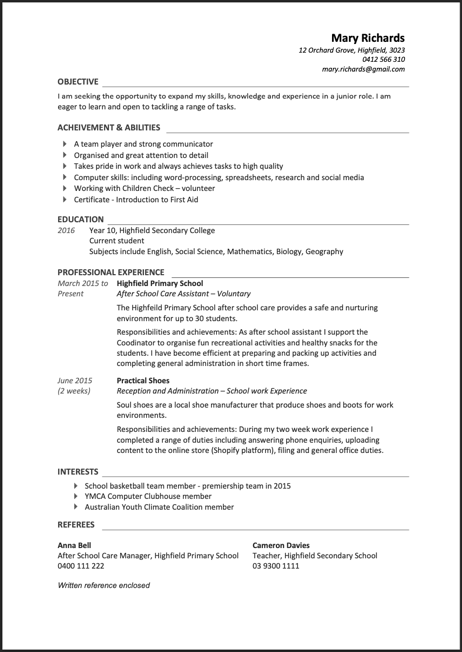
You can arrange your resume under the following headings.
Visit the myfuture website for a series of resume templates to help guide you.
Your Name and Contact Details
- Provide your full name (or preferred name). Include your postal address, phone number and email address.
Pro Tips:
- Make sure your phone has a clear voicemail message or that there is someone available to take a message for you.
- Be sure to include an email address that looks professional (i.e. nothing like sugar_coated@gmail.com).
- Make your name stand out in bold.
Objective
A career objective explains what you’re looking for and what you can offer. It shows that you’ve thought about what kind of work you want to do. Keep it brief (one or two sentences). It can be written to suit each job you apply for, or it can be more general to suit your overall career or job goals.
Achievements & abilities
Include any formal achievements, e.g. awards or certificates such as First Aid, a music or sports qualification. Now think about more informal achievements (things you’re proud of ) based on your activities, hobbies and interests both in school and out of school, e.g. clubs you belong to, tasks you help out with at home or in the community. Abilities refer to the skills you have listed in your Resume Builder document.
Education/Qualifications
- You can list your subjects and results or just name the last year of school you completed (where and when) – it’s up to you.
- Include any professional development such as short courses, workshops, and any other training completed.
Work History/Professional experience
Include any relevant work experience. Start with the most recent and work backwards.
- Include the job title for the position, name of employer and length of employment.
- Include a sentence about the employer - This shows you understand their core business/mission.
- Use bullet points to include some of the responsibilities you had in this job, including any achievements you had, whether it was an achievement for the organisation or yourself.
- Highlight the key skills and achievements you demonstrated in the role, starting with a power word (action verb).
Employment Skills/Job Requirements
- Include skills that are relevant to the job, and highlight your previous experience doing a similar role that shows you have the skills and personal traits the employer is looking for. Where possible, provide examples that demonstrate these skills in action.
- Job requirements could include things such as Driver’s License, Working With Children's Check, First Aid Certificate.
Interests
Writing a bit about what you do in your spare time helps an employer get to know you. It’s another chance to draw attention to your abilities and achievements. Include things like team memberships, long-term interests and any informal training you’ve done through a social club or community group. Keep them relevant to the job you are applying for or those that demonstrate your positive traits.
Referees
- Include the names and contact details of two referees.
- You can also add 'References available on request'. But be prepared for employers to ask for these as your application progresses.
Who can be a referee? Someone who knows you well, like a colleague, teammate, coach, mentor, teacher or another member of the community you've worked with or helped out. Avoid using family or close friends as referees unless there are no alternatives.
Pro Tips:
- Make sure you provide up-to-date contact details of your referees, and always make sure you have permission before including them in a resume.
- Always let your referees know if you’re going for an interview. This means they will be prepared and expect a call from the employer. It also helps to tell referees about the job you’re applying for so they can think about how your skills and abilities will be relevant.
Cover Letters
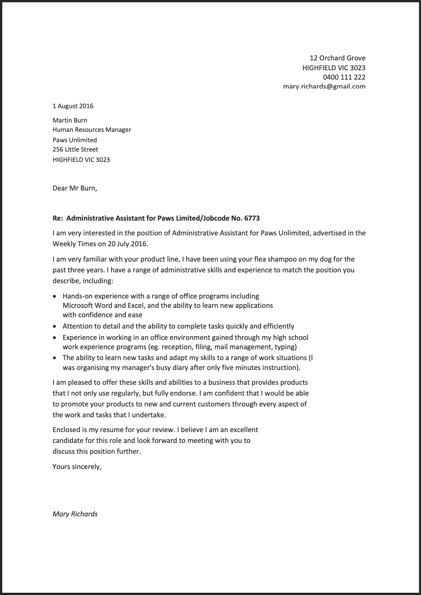
A cover letter aims to highlight your skills and attributes. It should be customised to respond to every job application. It’s an opportunity to showcase your relevant skills and experience succinctly, express your eagerness for the position, and highlight why you will be a good fit for the team.
Visit the myfuture website for a sample cover letter to help guide you.
Ingredients for a great cover letter
- Start with your name and contact details, current date, and employer contact details.
- Include an introductory paragraph that states the position you are applying for and why you are interested in the position by outlining.
- In a new paragraph, explain why you think you would best fit for the position by addressing each of the key skills and requirements. You could include your qualifications, experience, employability skills and personal attributes that effectively demonstrate your suitability for the role.
- State why you think you would fit in with the company culture and how much you like the company’s products/services. What it is about the job or company that appeals to you.
- Conclude by referring to your resume to support your suitability for the position and restate your enthusiasm for the position. Also, ask for an interview. Don’t be shy - this shows you are keen about the job.
Pro Tips
- Your letter should be customised for each job you apply for
- Use Effective keywords/ power words and statements in response to the job ad you’re applying for
- Make sure to spell check your application and ask someone to proofread your documents before applying
- No more than one page in length
- If the ad asks for you to respond to Key Selection Criteria, you can include the responses in the cover letter (in this case, it’s ok for the letter to be longer than one page)
Things to consider before applying
Social Media check
It’s not uncommon for employers to screen candidates by checking social media profiles. So go through all of the digital accounts you have created and make sure your photos and information have adequate privacy settings and are not embarrassing to your professional persona in your job search!
Job Searching – where are the jobs!
Finding a job as a young person is never easy; you’ll need to be responsive and innovative in your search for employment.
There are many different ways to find work, and each requires a variety of skills. Some people obtain work through someone they know or through a ‘friend of a friend’, through parents or other family friends. However, more often than not, an application has to be submitted for an advertised position.
Many jobs are advertised online using platforms like Jobs for Youth Career Hub, Seek or Sidekicker. You will usually need to follow the specific instructions to apply for each job and have a resume to be able to apply online.
Other ways can include social media, recruitment agencies, newspapers, and some larger companies post their job vacancies directly on their websites.
A helpful tip is to keep your options open and not just limit yourself to one role. Use a variety of job searching methods and explore other roles, just in case your first choice doesn’t work out.
Below you will find different ways you can search for jobs.
Common Job Search Websites
- www.seek.com.au
- www.indeed.com.au
- www.sidekicker.com/au/work
- www.ethicaljobs.com.au
- www.careers.vic.gov.au
- www.employment.gov.au
- www.jobsearch.gov.au
A job is a numbers game. The more applications you submit, the more likely you are to be successful. Try not to take knock backs personally. Keep trying and stay as positive as you can.
Hidden Job Market
More than half of all positions vacant are not advertised. Use your family and friends’ networks, make phone calls or email potential employers directly for possible jobs.
Networking
It is often easier to find work when you have connections in the industry. So don’t be shy to ask around and find out if there are any jobs available through family, friends and your wider community.
Networking can lead to job opportunities, check-in with people you already know:
- Family members and their workplaces
- Sporting clubs
- Neighbours, friends and acquaintances
- Local businesses - tradespeople, pharmacy, retail, hospitality and health clinics
- Volunteering experiences
Cold Calling
Cold calling is when you contact an employer about potential job opportunities.
At first, cold calling can be a little challenging. When you are contacting employers, ask for the name of the person who recruits and/ or hires new staff. Once you have their name, ask if you can be put through to them. Introduce yourself, tell them why you are calling and ask if you can have an interview. Make sure you have your resume in front of you and take notes!
Cold calls give you the opportunity to show your initiative and strong interest in the specific business.
Local
Keep an eye out in your local area in shop windows and community notice boards.
Job Interviews
You successfully gained an interview! What to do next.
Apart from being punctual and polite, proper preparation is the secret. You can never prepare enough, so here are some great ways to prepare for those all-important interview questions and build. Prior preparation will ensure you can confidently showcase your skills, knowledge and experience and will help reduce the anxiety involved in job interviews.
Tips for interview success
Know the job
- Find out as much as you can about the job you are applying for and what it involves. Demonstrating this knowledge shows that you have a good understanding of the job requirements and that you are confident you can perform the job.
- Carefully read over the job advertisement. Look for keywords and the key duties of the job. Think about how you can use these keywords in your responses in the interview and how you might respond if asked about your related experience to the job’s key duties.
Know the company
- Learn about the company that you’re applying to. Basic knowledge about the company will demonstrate to the employer that you have done your homework!
- Read their website, or Google them to learn about their products or services, target market and strategy.
Know your application
- Take some time to review your resume and cover letter. The employer may ask questions about your education and work history. Be ready to discuss these items in further detail, especially if you can highlight experiences that are closely related to the job.
Prepare your responses
- Prepare your answers to commonly asked interview questions. You can write the answers down or practise answering them with a friend or family member. Sell yourself and your abilities. Be prepared to show the employer how they can benefit from hiring you and that you’re enthusiastic about getting the job.
- Prepare questions to ask the employer at the end of the interview. This is a chance to find out more about the job and show your interest.
Prepare your journey there
- Know where you are going and always arrive early. Arrive at least 10 minutes before your interview time. This will show the potential employer that you are organised and very eager.
Prepare your appearance
- Dress for success! Your appearance should reflect your eagerness for the job. Select your outfit the day before. Clean and neat clothes, shoes and hair are important to show your respect for the employer.
Interview Performance techniques
Before you go in
Remember to turn your mobile phone off.
During the interview
Firstly, introduce yourself to the interviewer and shake hands. Sit down when asked.
Think about your answers
Take your time and express your words clearly. Don’t be afraid to pause and reflect on what you would like to say. If you don’t understand the question, it’s OK to ask them to repeat it. Or, if you can’t think of an answer straight away, take a moment to think and consider paraphrasing the question as you are thinking. There’s no need to rush.
Maintain eye contact
Body language leaves an impression, so maintain eye contact with your interviewers, especially when answering the questions. Sit upright and relaxed - Avoid fidgeting.
Sell yourself
Don’t forget, the topic of conversation in an interview is you! You are the expert on YOU. So don’t be shy about describing your best skills and experience; show them why you can do the job well.
After the interview
It is good to send a follow-up email thanking the employer for the interview. This shows that you are eager and considerate. It could make the difference between you and another candidate.
If you do not get the job, follow up with the interviewer for feedback to help you improve your interview performance and be considered for any future available roles.
The journey to find a job may take some time, but be patient, keep introducing yourself to potential employers and keep trying.
You got that Job! What’s next?
Whether you have landed yourself that first job or are still searching for the right pathway, it is important you know your rights and the types of behaviour expected in the workplace.
Here are some things to ask and find out about in your workplace:
1. Your employment conditions
2. Workplace health and safety
3. Hours of work and pay rate
4. Details of any probationary period
5. Any training that you will need to do during your employment
Most employers will ask you to fill out some paperwork once they have officially offered you employment. This paperwork consists of personal details, including your bank account and other personal information, to ensure you will be paid correctly.
Know your rights at work
As a worker, there are laws in place to protect you. It’s essential to know your rights and responsibilities in the workplace - to be safe, be paid correctly and have fair work conditions.
What are fair work conditions?
Fair work conditions are outlined in the National Employment Standards. Here are some examples:
- The number of hours of work per week
- How much leave you can take
- How much you should get paid
- Being treated fair
Getting paid correctly
Australian law sets the minimum wage rates, which establish the minimum amount that people must legally be paid for different kinds of jobs.
Check that you are getting paid correctly by checking the Fair Work website. fairwork.gov.au/pay
If you think there is something wrong with your pay, ask for advice from the following sites:
- Young Workers Rights - https://www.youngworkers.org.au
- JobWatch - https://www.jobwatch.org.au
- Fair Work Ombudsman - https://www.fairwork.gov.au/contact-us/call-us
13 13 94
What is a Tax File Number (TFN)?
If you are thinking about getting a job, you need to have a Tax File Number (TFN) so that your employer can deduct income tax from your wages as required.
Your (TFN) is a unique number given to you by the Australian Taxation Office (ATO). When filling in your Tax Declaration form you will have to include your TFN.
How can I get a TFN?
Australian residents can apply for a TFN:
- At an Australia Post branch
- At a Department of Health and Human Services (Centrelink) or Department of Veteran’s Affairs centre
- Online at ato.gov.au/Individuals/Tax-file-number/Apply-for-a-TFN/
The cost is free, and your TFN is yours forever. That means you don’t have to apply again. Keep your TFN safe as it will be used to confirm your identity for new jobs and to access your superannuation.
What is Superannuation?
Superannuation is another term you will soon be familiar with once you find a job. Superannuation is money that your employer puts aside for you on your behalf for your retirement.
So why do we need to be thinking about retirement now? Because throughout your working life, these contributions from your employer accumulate so that when you retire, you will have money to live off.
How does super work?
Your 'super money' is money that comes from contributions made into your super fund by your employer and topped up with your own money. Your employer is expected to pay 10.5% of your salary into a super fund by law.
If you think your employer isn't paying the right amount of super, or if they're not paying it at all, you can contact your super fund or contact the Super Helpline on 131 020.
How do I choose a super fund?
If your employer does not have a preferred super fund and you want to choose your own, tell your employer by filling in a Standard Choice form from the Australian Taxation Office (ATO) or from your employer.
If you don't choose a super fund when you start a new job, your employer will pay contributions for you into a default fund that they choose or one that has been identified in an Industrial Act.
For further information on eligibility for super and all the different super funds to select from, check out the Australian Taxation Office website ato.gov.au/individuals/super/getting-your-super-started/.
Safety at work
When starting a new job, you are entitled to receive information about how to conduct your job safely and how to use safety equipment. If you feel unsure about how to do a task safely, you are entitled to ask questions.
Don’t be afraid to say NO to an unsafe task. You can ask questions about safety to your manager, health and safety representatives, union representative or Work Safe.
If you become injured at work, get medical attention and let your manager know what happened straight away.
Follow the steps on the Work Safe website or get free and confidential advice at worksafe.vic.gov.au.
Employee expectations
Most employers have specific expectations and policies about how you should behave in the workplace. These should be discussed with you when you first start your job.
Here are some basic responsibilities:
- Your position description is a guide as to what is expected of you.
- Be on time. Call and let your employer know if you are sick or running late.
- Treat your workmates, managers and customers or clients with respect.
- Be mindful of how you present yourself and the language you use.
- Be mindful of how you communicate via email, phone and social media.
Making the right impression on the first day at a new job is essential. Be on time, positive and go in with an open mind. Introduce yourself to your colleague in a polite and friendly manner, ensuring you make eye contact.
Remember that it's okay to ask questions.
-

- Promote local employment to your region, community or member organisation with a uWorkin Talent Community. Find out more.